


1. THE SCIENTIFIC BACKGROUND
In one of our most read KIW Research Note we saw that when the goal is to optimize the aerobic adaptations from high intensity training (HIT, above the second threshold/Critical Power of FTP) training, the key is to accumulate as much time as possible at a high % of the maximum oxygen consumption (VO2max).
Regarding this, we saw that the short high intensity intermittent intervals (series of 8-13 min with 3-5 min recovery between where you alternate 15-40s ‘on’ and 15-30s ‘off’ in a 1:1 or 2:1 ratio) are better than traditional long HIT intervals (3-5 minutes work phases with 1:1 or 2:1 work-recovery ratio). It seems like the capacity to work at a higher intensity despite a similar rate of perceived exertion and total time spent at a high intensity power is what make short intervals superior in promoting aerobic adaptations.
Furthermore, during long intervals, the longer recovery periods—required to sustain the subsequent long work bouts—allow oxygen uptake (VO₂) to drop substantially. As a consequence, the initial portion of each new long interval is spent rebuilding VO₂ rather than working at a high percentage of VO₂max. This results in a lower time spent at a high fraction of VO₂max across the entire session.
In contrast, the short recovery periods typical of short intermittent intervals prevent VO₂ from declining markedly. Oxygen uptake remains elevated throughout the session, leading to more time accumulated at a high percentage of VO₂max.
This is illustrated in the figure below, which shows oxygen consumption during a long HIT session (LI), consisting of alternating 3-min work bouts with 2-min recovery, and a short HIT session (SI), consisting of alternating 30-s work and 20-s recovery. In both protocols, the work phases are performed at ~120% of critical power, corresponding to Zone 5 in a 5- or 7-zone intensity model.
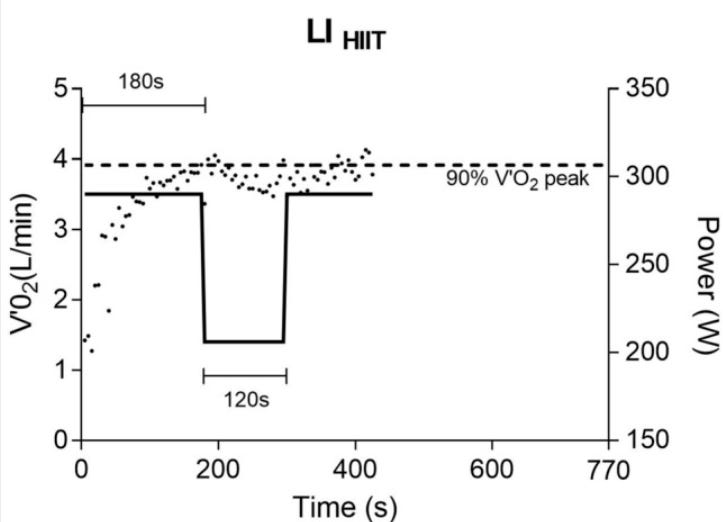
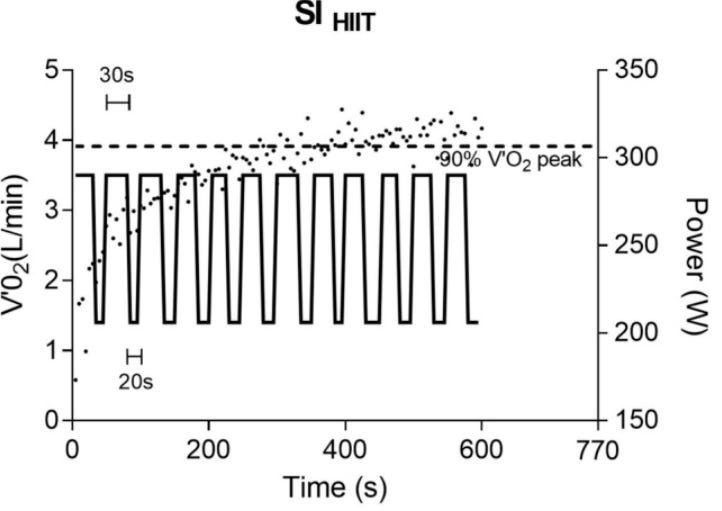
However, it is also evident that in the long-interval format, VO₂ (oxygen consumption) kinetics—that is, how quickly oxygen uptake rises toward a high fraction of VO₂max at the beginning of the interval—is faster than in the short-interval format. For example, after ~180 s, VO₂ typically reaches ~90% of VO₂max during long intervals, whereas during short intermittent intervals it often remains well below this threshold at the same time point.
As is often said, training lies somewhere between art and science. So, our goal is to combine physiological principles creatively rather than just copy and past studies’ protocols. With this in mind, an optimal strategy can be to exploit both the faster VO₂ kinetics at the onset of exercise provided by long intervals, while also maximizing the average time spent at a high percentage of VO₂max and the accumulated time above 90% of VO₂max typical of short intervals. This can be achieved by starting the workout with one long interval, followed by a short recovery period and then continue with a full short intermittent format.
This combined approach can be called ‘pre-loaded short intermittent intervals’. In line with the physiological principles described above, this format appears to be a highly effective strategy for optimizing aerobic gains induced by high-intensity training.
Here below you can find an example of such a high-intensity workout format!
Please note that, as stated above, here we are talking about optimizing aerobic adaptations derived from the HIT sessions. Of course you can still include a 8x1min all-out with 3 min recovery or a 10x15s all-out with 5min recovery HIT sessions in your annual training plan. However the goals of these HIT sessions are to improve anaerobic capacity and neuromuscular power respectively, not aerobic adaptations.
