5. A PRACTICAL EXAMPLE ON HOW TO FUEL A CLASSIC 'MONUMENT' IN A WORLD TOUR ROAD CYCLIST - BY DR RITA CIVIL AND DR TIM PODLOGAR


This KIWApplied has been written by:
Rita Civil PhD and Tim Podlogar PhD

Dr Rita Civil is a Physiologist and Sport Nutritionist with a major interest in exercise metabolism, having published several scientific papers on the topic. She completed the International Olympics Committee (IOC) Diploma in Sport Nutrition and has vast experience working with professional and elite athletes. You can contact her at rita.civil@gmail.com

Dr Tim Podlogar is a Lecturer in Applied Physiology at the University of Exeter. He is an expert in exercise physiology and carbohydrate metabolism and has extensive experience working with elite endurance athletes and is currently a consultant for Tudor Professional Cycling Team. You can find him on Instagram: @tpodlogar
We are delighted to have such professional contributors to Knowledgeiswatt!
Enjoy the read!
In our last KIW Research Note we discussed the science behind how to fuel a long one-day cycling road race, such a classic monument in world-tour professional cycling. In this KIWApplied, we do a quick recap on this scientific background, and we show a practical example where we apply this knowledge for a Paris-Roubaix nutrition strategy. If you are interested in the deeper scientific context including all the research references you can visit our previous Research Note here.
1. SCIENTIFIC BACKGROUND
1.1 Glycogen Loading (~24 h before)

Skeletal muscle glycogen is a key carbohydrate fuel for intense exercise, and starting a long race (>3 hours) with full or super-compensated muscle glycogen stores is crucial because low glycogen causes fatigue and reduced muscle function. Current scientific evidence shows that trained athletes can maximise glycogen in just 24 hours using a short high-intensity effort followed by a very high-carbohydrate diet. For example, doing a relatively short, easy ride with a few 1-3 min bursts in the morning of the day before the race and immediately start carbohydrate loading with 10-12 g/kg of carbohydrates (including high glycaemic) for the remainder of the day. This strategy takes advantage of increased insulin sensitivity and glucose transport into muscle after exercise.
Although glycogen loading increases body mass due to water retention, this has little negative effect in long races because it is functional mass and the majority of the glycogen will be used by the time riders reach the crucial parts of the race. All competitive cyclists, including moderately trained and elite cyclists should follow similar glycogen loading protocols (~10 g/kg/day of carbohydrates), regardless of sex/gender as female athletes can also super-compensate muscle glycogen effectively when total energy intake is sufficient.
1.2 Pre-race meal

Overnight fasting reduces liver glycogen but not muscle glycogen stores, so breakfast or morning meal before a race should prioritise restoring liver carbohydrate stores with fructose and/or galactose (i.e., milk sugars) containing foods, since these two sugars are primarily metabolised in the liver. A pre-race meal should be low in fibre and relatively low in fat and protein (so that it is easy to digest) whilst providing 1-4 g/kg of carbohydrates depending on how many hours remain until the race. This can translate into 3 g/kg of carbohydrates consumed during the 3 hours before the start of the race. When the race-start is in the late morning, a practical strategy can be having a mixed-breakfast about 3 hours before the start (with ~2.3 g/kg carbohydrates) plus simple carbohydrates, such as sport gels or sweets, ingested during the warm-up or a few minutes before the start (with ~0.7 g/kg carbohydrates). This regime also aims to avoid the potential for rebound hypoglycaemia. Early-morning amateur races with early-morning start times may require a smaller, easily digested pre-race meal of roughly 2-2.5 g/kg carbohydrate.
1.3 Fuelling on the bike

Carbohydrate intake during the race (i.e., exogenous carbohydrate intake) is essential for maintaining blood glucose, supporting high carbohydrate oxidation, and preserving liver glycogen during long cycling efforts. When ingesting glucose or its polymers (e.g., maltodextrin) alone, intestinal absorption limits oxidation to ~60 g/h, but adding fructose increases absorption capacity and allows for higher oxidation rates. For events lasting up to 3 hours, 60-90 g/h is usually sufficient, however, beyond 3 hours, liver glucose output becomes increasingly important as muscle glycogen is becoming depleted and muscle glucose uptake is increasing to meet carbohydrate demands. In highly trained male cyclists, these increased demands for carbohydrates coming from the bloodstream exceed oxidation (i.e., absorption) from exogenous carbohydrates, even when ingested at 90 g/h.
Recent studies investigating intakes of 120 g/h (with a glucose-fructose mix at a 1:0.8 ratio) during a 3-hour steady state cycling exercise in trained male cyclists have reported that these higher exogenous carbohydrate amounts can be well tolerated and allow for greater oxidation rates compared to intakes of 90 g/h. But performance benefits beyond 90 g/h are not yet proven.
Differences in body size, sex, or gut training cannot fully explain individual differences in exogenous carbohydrate oxidation rates, so personalised carbohydrate strategies based on laboratory-based oxidation capacity tests may be good option, as they can minimise the occurrence of gastrointestinal discomfort as well as reduce perceived effort. Additionally, personalising exogenous carbohydrate intake up to the individual’s maximal oxidation capacity can lower the risks of accelerating endogenous carbohydrate (i.e., glycogen) use. For most cyclists, ~90 g/h, as glucose-fructose mix in a 2:1 or 1:08 ratio, remains the safest universal target for events that are longer than 3 hours.
1.4 Key supplements

Caffeine and sodium bicarbonate are the primary evidence-supported supplements for long road races.
Caffeine:
Caffeine acts as an effective performance-enhancing supplement by its effects on the central nervous system (reducing perceived effort, increasing alertness and reaction speed). Moderate doses (around 1.5-3 mg/kg) taken 40-60 minutes before racing are typically effective, while higher doses offer no additional performance benefit and increase the likelihood of unwanted side effects such as jitters, anxiety, or stomach discomfort. In long races, caffeine can also be strategically only taken later in the event (100-200 mg) before decisive climbs, attacks, or sprint finishes, preventing feeling impulsive and risk-taking actions in the first part of the race and unnecessarily wasting energy by riding more “aggressively”.
Sodium bicarbonate:
Bicarbonate enhances performance by increasing the body’s extracellular buffering capacity, which helps neutralise muscle acidosis during intense efforts above critical power, resulting in delayed fatigue, and enhancing muscle capacity. Doses of 150-300 mg/kg of bicarbonate (taken as a sodium bicarbonate supplement) consumed 2-3 hours before a race are an effective strategy to improve cycling performance of short maximal efforts. During-race supplementation with 50-150 mg/kg sodium bicarbonate can also support late-race sprint ability. Some individuals experience gastrointestinal discomfort, but this can be reduced if sodium bicarbonate is taken with fluids and high-carbohydrate meals/foods and also by using hydrogel or enteric-coated products. Because of its high sodium content, athletes should also limit additional salt or electrolyte intake around the same time.
2. THE PRACTICAL EXAMPLE
Here we show a fictional example of a nutritional strategy for long cycling race (classic monument) using the scientific background described above.
The scenario is the following:
Our imaginary rider is a 77 kg male world-tour professional cyclist.
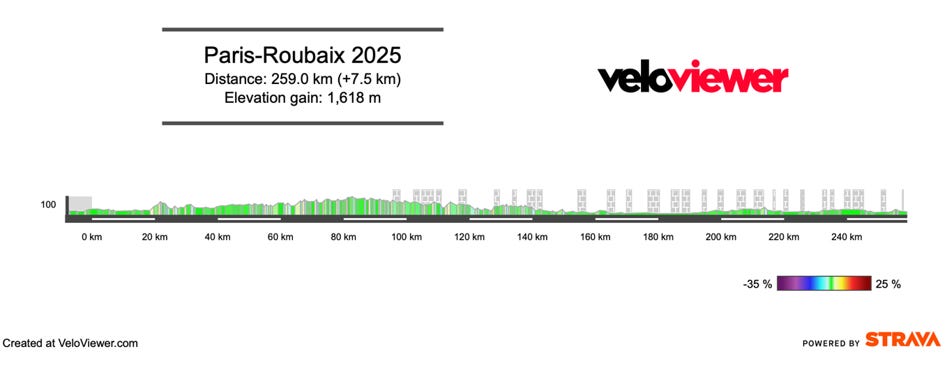
The race is the 122nd Paris-Roubaix (2025). The goal is to stay in the main peloton for as long as possible, aiming for a top 10 result.
Start time 11:25 h