
136. OPTIMIZING HIT AEROBIC WORKOUTS: THE DECREASING LENGTH INTERVALS


The search for optimized HIT sessions is based on understanding exercise physiology principles and how to exploit them by manipulating intensity, work, and recovery to maximize the training stimulus.
In this scenario, in one of our most read KIW Research Note we saw that when the goal is to optimize the aerobic adaptations from high intensity (above the second threshold/Critical Power of FTP) training, the key is to accumulate as much time as possible at a high % of the maximum oxygen consumption (VO2max).
Regarding this, we saw that the short high intensity intermittent intervals (series of 8-13 min with 3-5 min recovery between where you alternate 30-40s ‘on’ and 20-40s ‘off’ in a 1:1 or 2:1 work-recovery ratio) are better than traditional long HIT intervals (3-4 minutes work phases with 1:1 or 2:1 work-recovery ratio). It seems like the capacity to work at a higher power and fraction of VO2max despite a similar rate of perceived exertion is what make short intervals superior in promoting aerobic adaptations. One contributing factor is that during long intervals, the longer recovery periods—required to sustain the subsequent long work bouts—allow oxygen uptake (VO₂) to drop substantially. As a consequence, the initial portion of each new long interval is spent rebuilding VO₂ rather than working at a high percentage of VO₂max. This results in a lower time spent at a high fraction of VO₂max across the entire session. In contrast, the short recovery periods typical of short intermittent intervals prevent VO₂ from declining markedly. Oxygen uptake remains elevated throughout the session, leading to more time accumulated at a high percentage of VO₂max.
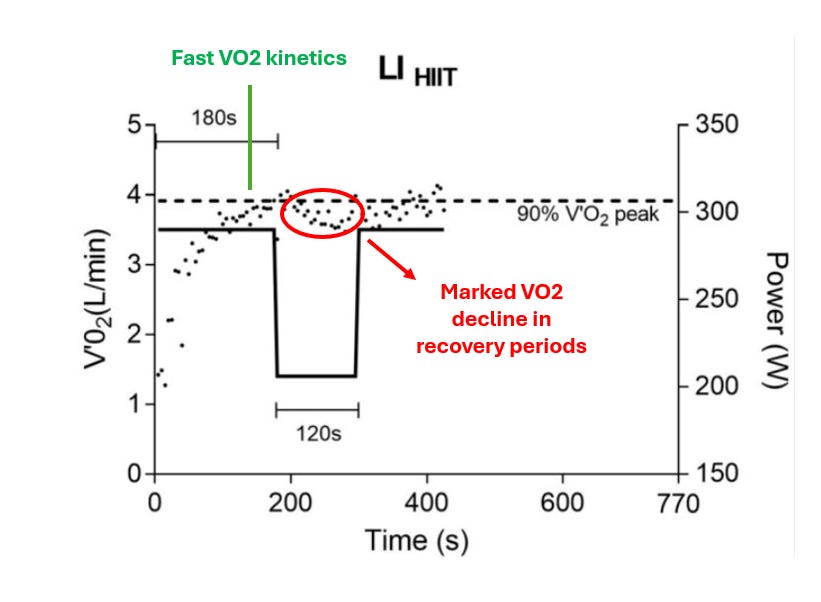
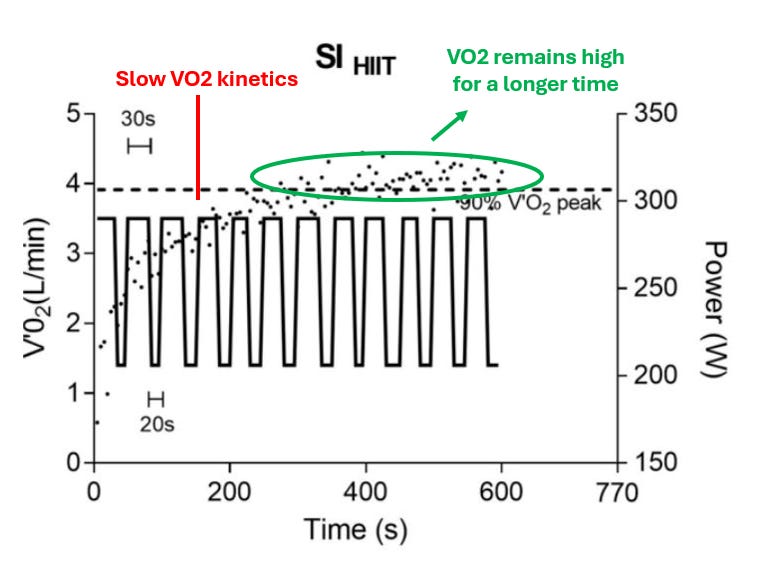
Taking the concept one step further, in the latest KIWApplied we explored a creative combination of long and short intervals designed to further optimize the time spent at a high percentage of VO₂max, and therefore enhancing aerobic adaptations:
The Pre-Loaded Short Intermittent Intervals.
This format combines long and short intermittent intervals within each series. How? Each series starts with a long interval (2–4 minutes, the ‘pre-load’), followed by a short recovery period (30s-1min), and then continues with 8–10 minutes of intermittent work. With this structure, athletes can exploit the faster VO₂ kinetics at exercise onset induced by the long interval, while simultaneously maximizing both the average time spent at a high percentage of VO₂max and the accumulated time above 90% of VO₂max, which are typically associated with short-intermittent intervals.
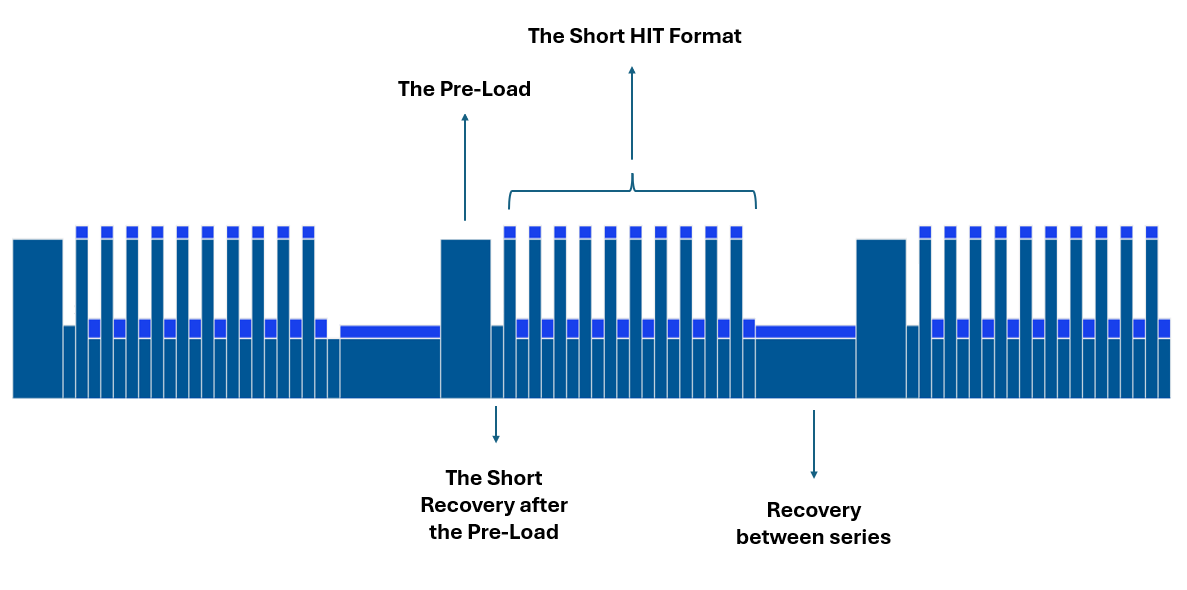
How is possible to go from a the pre-load long interval straight into the short intermittent intervals series with just a short (30s-1min) interval?
Another key physiological principle which could be relevant trying to maximise the aerobic effectiveness of a HIT session relates to recovery kinetics. Following work performed above critical power (approximately FTP/second threshold), recovery processes—such as H⁺ removal, phosphocreatine (PCr) resynthesis, and so the reconstitution of the anaerobic reserve (W’)—follow an exponential time course. In practical terms, this means that the capacity to produce high-intensity work is restored very rapidly immediately after the end of an effort, while the rate of recovery progressively slows as recovery time increases.
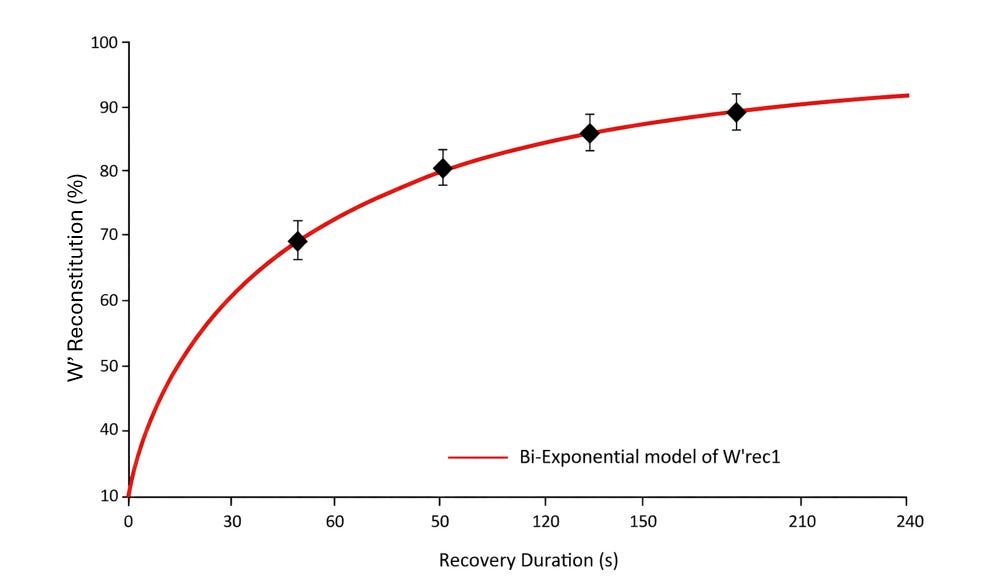
How can this be applied in practice?
Using a HIT format with decreasing length intervals. This approach could allow athletes to accumulate more time at a high % of 𝑉O₂max, thereby enhancing the aerobic stimulus of the session. How?
Starting with a long first interval (typically 2–4 minutes) which helps oxygen consumption rise rapidly toward near-maximal values.
Once a high ˙𝑉O₂ is reached, decreasing length work intervals with decreasing length recovery period make it possible to have enough restoration to complete the next shorter effort while preventing ˙𝑉O₂ from dropping substantially.
Does decreasing length HIT intervals optimize the time spent at high % of VO2max (and so likely aerobic adaptations) when compared with traditional short intermittent and long HIT intervals?
A study published by Vaccari and Colleagues (Department of Medicine, University of Udine) on European Journal of Applied Physiology in 2020 tried to answer this question. (1)
